Why Install Laminate Flooring Yourself?
Professional laminate installation typically costs $1.50 to $3.00 per square foot for labor alone. For a 300 sq ft room, that is $450 to $900 you can save by doing it yourself. Modern laminate flooring uses a click-lock system specifically designed for DIY installation — no special training, no expensive tools, and no glue required. Most homeowners can complete a standard room in a single weekend.
The click-lock mechanism is genuinely foolproof. Each plank snaps into the previous one at an angle, creating a tight, seamless joint without adhesives. If you can use a tape measure and a saw, you can install laminate flooring. This guide walks you through every step with pro-level tips that will make your installation look like it was done by a seasoned contractor.
Tools and Materials You Will Need
Essential Tools
- Tape measure (25 ft minimum)
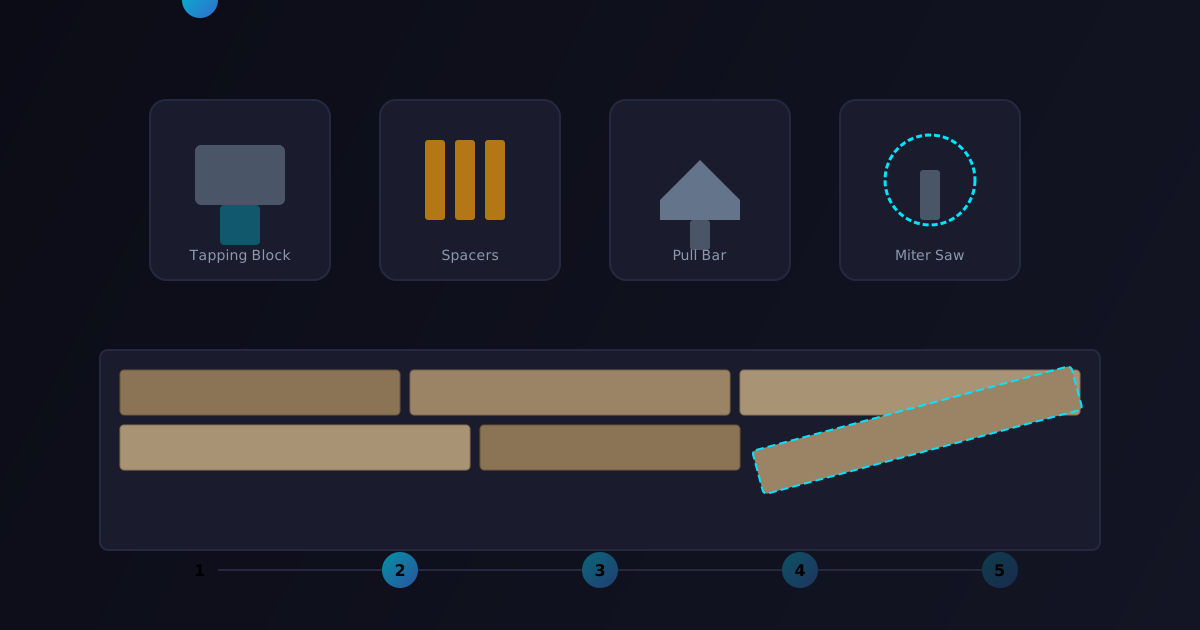
- Tapping block — protects plank edges during installation
- Pull bar — essential for the last plank in each row
- Spacers — maintain the expansion gap (usually 1/4 inch)
- Rubber mallet — for tapping planks into place
- Miter saw or circular saw — for cutting planks to length
- Jigsaw — for cutting around door frames and obstacles
- Utility knife — for trimming underlayment
- Pencil and straight edge
- Safety glasses and knee pads
Materials
- Laminate planks (area + 10% waste — use our box calculator to find the exact number of boxes)
- Underlayment rolls (if not pre-attached to planks)
- Moisture barrier film (for concrete subfloors)
- Transition strips (for doorways between rooms)
- Quarter round or baseboards
Step 1: Prepare Your Subfloor (Day Before)
A proper subfloor is the foundation of a great laminate installation. Skip this step, and you will end up with squeaky, uneven floors.
- Remove existing flooring — pull up old carpet, vinyl, or tile. Leave smooth concrete or plywood exposed.
- Clean thoroughly — vacuum all dust, debris, and staples. Even a small pebble under laminate creates an annoying bump.
- Check for level — use a 6-foot straightedge or level. Deviations should be no more than 3/16 inch over 10 feet. Use floor leveling compound for low spots and sand down high spots.
- Moisture test — for concrete subfloors, tape a 2×2 ft piece of plastic sheeting to the floor for 24 hours. If moisture collects underneath, you need a vapor barrier.
- Fix squeaks — screw down any loose plywood panels to the joists below.
Step 2: Acclimate the Laminate (48–72 Hours)
This is the step most beginners skip — and regret. Laminate planks must acclimate to your room's temperature and humidity before installation.
- Bring unopened boxes into the room where they will be installed
- Leave them for 48 to 72 hours minimum
- Keep the room at normal living temperature (65°F – 80°F)
- Maintain humidity between 35% and 65%
Skipping acclimation causes planks to expand or contract after installation, leading to buckling, gaps, or warping. This is the number one cause of DIY laminate failures.
Step 3: Install Underlayment
If your laminate planks do not have pre-attached underlayment padding, you need to lay it separately. For concrete subfloors, install a moisture barrier first.
- Roll out underlayment perpendicular to the direction you will lay planks
- Butt edges together — do not overlap
- Tape all seams with underlayment tape
- Trim excess at walls with a utility knife
- Only lay one row of underlayment at a time to avoid stepping on it
For a deeper dive on underlayment options, check our complete underlayment guide.
Step 4: Lay the First Row
The first row sets the foundation for your entire floor. Take your time here.
- Choose your starting wall — start along the longest, most visible wall in the room
- Place spacers — set 1/4-inch spacers against the wall to maintain the expansion gap
- Lay the first plank — tongue side facing the wall, groove side facing the room
- Connect end joints — angle the next plank at about 20° and press down until it clicks
- Cut the last plank — measure the remaining space, subtract 1/2 inch for expansion gaps on both ends, and cut with a miter saw
- Important rule: The cut-off piece from the last plank becomes the first plank of the next row — but only if it is at least 12 inches long
Step 5: Continue Row by Row
Now you are in the rhythm. Each subsequent row follows the same pattern:
- Stagger joints — end joints between adjacent rows must be offset by at least 12 inches (some manufacturers require 16 inches). This is critical for both structural integrity and appearance.
- Angle and click — tilt the long side of each plank at 20° into the previous row's groove, then press down until it locks
- Use the tapping block — gently tap plank ends together using the tapping block and rubber mallet. Never hit the plank directly — you will damage the click-lock profile.
- Check alignment — every 3–4 rows, step back and verify your rows are straight and gaps are tight
Step 6: Handle Door Frames and Obstacles
Door frames are the trickiest part of any laminate installation. Here is the professional approach:
- Undercut the door jamb — lay a scrap piece of laminate flat against the door frame and use an oscillating multi-tool or hand saw to cut the jamb at that height. The plank should slide underneath the frame for a seamless look.
- Around pipes — drill a hole 1/2 inch larger than the pipe diameter, make a straight cut to the hole, slide the plank in, and glue the cut piece back.
- Transitions — install T-molding or reducer strips in doorways where your laminate meets another flooring type.
Step 7: The Last Row
The final row almost always requires rip-cutting planks to width.
- Measure the remaining gap at multiple points (walls are rarely perfectly straight)
- Subtract 1/4 inch for the expansion gap
- Mark and cut planks lengthwise using a table saw or circular saw with a guide
- Use the pull bar to click the last row into place — there is not enough room for a tapping block
Step 8: Install Trim and Transitions
- Remove all spacers
- Install baseboards or quarter round to cover the expansion gap
- Nail trim into the wall, not the floor — the floor must float freely
- Install transition strips in doorways
- Rehang doors — you may need to trim the bottom if the new floor height is different
7 Common DIY Mistakes to Avoid
- Skipping acclimation — causes buckling and gaps within months
- Not checking subfloor level — creates squeaks and uneven surfaces
- Insufficient stagger — H-patterns look unprofessional and weaken the floor
- Forgetting expansion gaps — the floor needs room to breathe; without gaps it will buckle
- Tapping directly on plank edges — destroys the click-lock profile
- Not undercutting door frames — visible gaps around frames look terrible
- Using wrong underlayment — concrete subfloors need a moisture barrier
How Much Will You Actually Save?
Let us crunch the real numbers for a 300 sq ft room with mid-range materials:
- DIY total cost: ~$1,200 (materials + tools)
- Professional total cost: ~$2,400 (materials + labor)
- Your savings: $1,200 — plus you now own the tools for future projects
Use our laminate flooring cost calculator to get your exact savings estimate. Simply set the labor cost to $0 for DIY and compare with the professional rate.