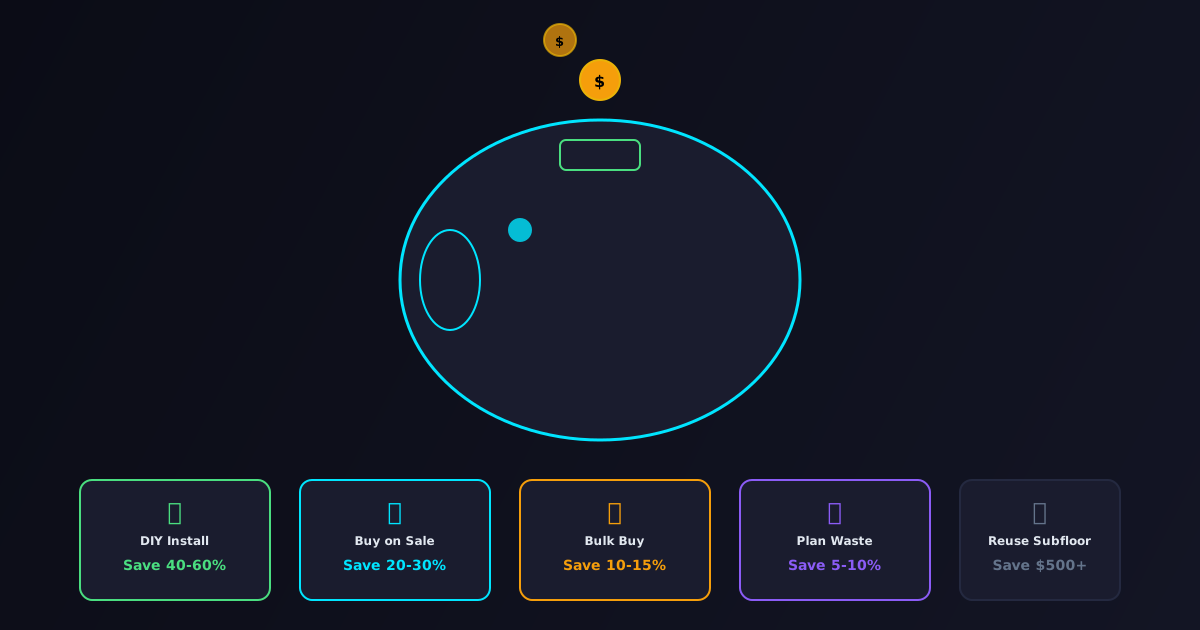
1. Install It Yourself (Save 40–60% on Labor)
The single biggest way to reduce your total project cost is to handle the installation yourself. Professional labor typically costs $1.50 to $3.00 per square foot — for a 500 sq ft project, that is $750 to $1,500 you can keep in your pocket. Modern laminate uses click-lock floating floor systems specifically designed for DIY installation. No nails, no glue, no special subfloor preparation required.
A complete beginner can install laminate at a rate of about 100–150 sq ft per day. That means a 500 sq ft project takes a long weekend. The tools you need — tapping block, pull bar, spacers, and a miter saw — cost about $100–$200 total and you can reuse them for future projects. Check our complete DIY installation guide for step-by-step instructions.
Potential savings for 500 sq ft: $750 – $1,500
2. Buy During Holiday Sales and Clearance Events
Flooring retailers run major sales during predictable periods throughout the year. The deepest discounts (20–40% off) typically happen during:
- Black Friday / Cyber Monday (November) — the biggest sales of the year
- Presidents' Day Weekend (February) — major home improvement sale season
- Memorial Day / Labor Day (May/September) — seasonal clearance events
- January clearance — retailers clear out old stock to make room for new lines
Additionally, watch for discontinued style clearances year-round. When manufacturers introduce new collections, retailers slash prices on outgoing styles by 30–50%. The quality is identical — only the color or pattern is being retired. Sign up for email newsletters from Home Depot, Lowe's, Floor & Decor, and Lumber Liquidators to get notified of sales.
Potential savings: 20–40% off material costs
3. Compare Prices Across Multiple Retailers
The same laminate brand can vary by $0.50 to $1.50 per sq ft between retailers. For a 500 sq ft project, that price difference means $250 to $750 in savings just by shopping around. Always check prices at:
- Home Depot — widest in-store selection, frequent sales
- Lowe's — price-matches Home Depot, different brand exclusives
- Floor & Decor — specialist retailer with competitive pricing on premium brands
- Lumber Liquidators (LL Flooring) — aggressive pricing on mid-range and budget options
- Costco — limited selection but excellent bulk pricing on Mohawk and Shaw
- Online retailers — BuildDirect, Wayfair, and Amazon often beat local store prices
Pro tip: Many retailers offer price-match guarantees. Find the lowest price online, then ask your preferred local retailer to match it — you get the best price with the convenience of local pickup and returns.
4. Choose the Right Quality Tier for Your Needs
Not every room needs premium $5/sq ft laminate. A smart approach is to mix quality tiers based on room usage:
- High-traffic areas (living room, kitchen, hallways): Mid-range AC4 rated, $2.50–$4.00/sq ft
- Bedrooms: Budget AC3 rated, $1.00–$2.00/sq ft — lower traffic means budget quality is perfectly adequate
- Guest rooms / closets: Entry-level, $0.70–$1.50/sq ft
By using budget laminate in low-traffic rooms and investing in quality only where it matters, you can reduce your overall material cost by 25–35% compared to using mid-range everywhere. Use our cost calculator to model different scenarios.
5. Remove Old Flooring Yourself
Contractors charge $0.75 to $1.50 per square foot just for old floor removal. This is pure labor — no special skills needed. Pulling up old carpet takes about 2 hours for a 300 sq ft room. Vinyl and linoleum removal takes a bit longer but is still straightforward with a floor scraper ($15–$25 at any hardware store).
For a 500 sq ft project, DIY removal saves $375 to $750. Plus, you save on disposal fees by hauling old materials to the dump yourself (typically $20–$50 per load versus $100–$200 for contractor disposal).
6. Minimize Waste with Smart Planning
The industry standard waste factor is 10%, meaning you buy 10% more material than your measured area. However, you can reduce this to 5–7% with careful planning:
- Measure precisely — use our square feet calculator to get exact room areas
- Plan your layout — use our layout calculator to optimize plank placement and minimize cuts
- Reuse cutoffs — the end piece from one row becomes the starter for the next row
- Order in full boxes — use our box calculator to determine the exact number of boxes needed
Reducing waste from 10% to 6% on a 500 sq ft project at $3/sq ft saves you $60. Small, but it adds up when combined with other strategies.
7. Skip the Contractor — Hire a Handyman
If DIY is not your style but you want to save on labor, consider hiring a handyman instead of a flooring contractor. Licensed flooring contractors charge $2.50–$4.00/sq ft for installation. A skilled handyman typically charges $1.00–$2.00/sq ft or a flat day rate of $200–$400. The quality of a handyman installation is usually comparable for straightforward rooms — the main advantage of contractors is for complex layouts with lots of angles, transitions, and stairs.
8. Use Laminate with Pre-Attached Underlayment
Separate underlayment costs $0.25–$1.00/sq ft for materials plus labor time. Many mid-range laminate brands include underlayment pre-bonded to the plank bottom. While the planks cost $0.30–$0.50 more per sq ft than bare planks, you save on the separate underlayment purchase AND reduce installation time by 30 minutes per room. Net savings: $0.10–$0.50/sq ft.
9. Keep Your Existing Baseboards
New baseboards and quarter round cost $1.00–$3.00 per linear foot installed. For a 300 sq ft room with 70 linear feet of wall, that is $70–$210 in trim alone. Instead, carefully remove your existing baseboards before installation, then reinstall them after the laminate is laid. Use quarter round ($0.30–$0.80/linear ft) to cover the expansion gap if your existing baseboards do not reach the new floor level.
10. Get Multiple Quotes and Negotiate
If you are hiring a professional, always get at least three written quotes. Prices can vary dramatically between contractors, and having competing quotes gives you leverage to negotiate. Ask each contractor to itemize their quote — materials, labor, removal, trim, and disposal should all be separate line items. This transparency lets you compare apples to apples and identify inflated charges.
Additional negotiation strategies that work:
- Bundle rooms — offer to do the entire house at once for a volume discount (10–15% off labor)
- Be flexible on timing — contractors charge less during their slow season (typically November–February)
- Supply your own materials — contractors mark up materials 15–30%. Buying directly saves that margin.
- Pay cash — some contractors offer 3–5% discounts for cash payment
How Much Can You Actually Save?
Let us model a real-world scenario for a 500 sq ft project:
| Strategy | Savings |
|---|---|
| DIY installation | $1,000 |
| Holiday sale (25% off materials) | $375 |
| DIY old floor removal | $500 |
| Reduced waste (10% → 6%) | $60 |
| Reuse existing baseboards | $150 |
| Total Potential Savings | $2,085 |
That is a 55% reduction from the typical professional installation cost of $3,800 for a 500 sq ft mid-range project. Use our laminate flooring cost calculator to model your own savings scenarios with exact numbers for your project.